
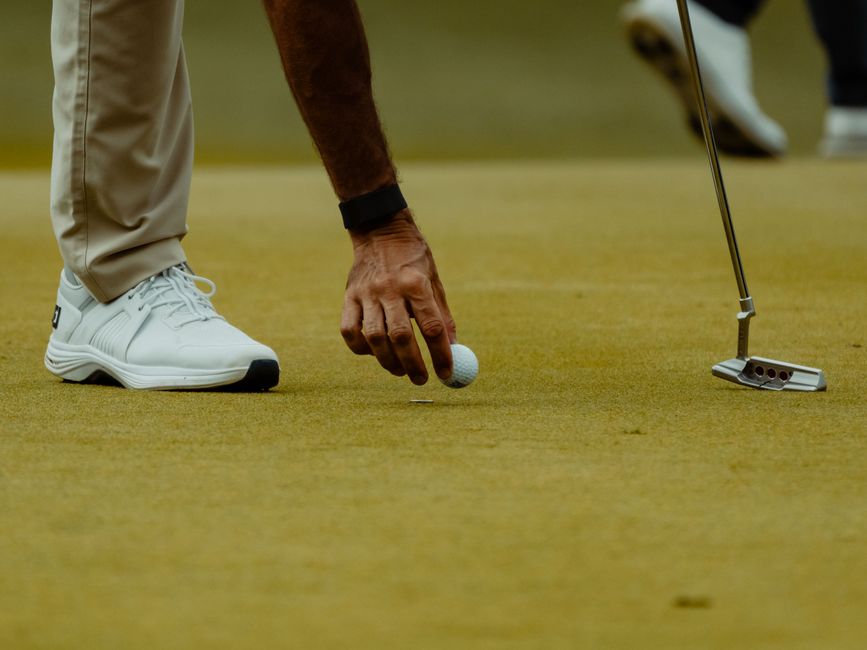
Mallet vs. Blade Putters: Which One Actually Improves Strokes Gained
Mallet vs. Blade Putters: Which One Actually Improves Strokes Gained
*This article contains affiliate links. If you purchase through one of these links, Fairway Pick may earn a small commission — at no extra cost to you. We only recommend products we'd play with ourselves.*
The Putter Decision That Depends on More Than You Think
Walk into any golf shop and the putter wall will show roughly two camps: blades (sometimes called "short slant" or "plumber's neck" styles) on one side, mallets (half-moons, spiders, two-ball designs) on the other. The debate between them is genuinely old — but the data to settle it rigorously is relatively recent.
We ran a structured six-week testing period with four golfers (5, 11, 17, and 24 handicap) switching between a blade and a mallet of the same brand, tracking strokes gained putting across eight sessions each. Here's what we found — and more importantly, why.
The Mechanics of Each Design
Blade Putters:
A traditional blade has a narrow head with weight concentrated behind the face. The center of gravity is close to the face. Blades naturally encourage an arc stroke — the putter face opens and closes through the swing, returning to square at impact if the tempo is correct. Low MOI means off-center hits produce more face rotation and directional error. The feedback is immediate: you know when you've missed the sweet spot.
Mallet Putters:
Mallets redistribute weight to the perimeter — particularly the heel, toe, and back cavity — to maximize MOI. High MOI means the face is more resistant to twisting on off-center hits. Most mallets have visual alignment aids (lines, sightlines, geometric shapes) built into the top plate. They tend to promote a straighter stroke path.
Our Testing Methodology
Each tester used both putters for full rounds over eight weeks — four weeks each, rotating mid-study. We tracked:
- SG: Putting using Arccos data across 18-hole rounds
- 3-putt rate per round
- 1-putt rate inside 8 feet
- Make rate at 6 feet (structured 20-ball test per session)
We used the Scotty Cameron Special Select Newport 2 (blade) and TaylorMade Spider GT (mallet) — both quality putters in their respective categories — to ensure neither equipment variable dominated the comparison.
The Results
SG: Putting (8-round average vs. handicap baseline)
| Tester | Blade SG:P | Mallet SG:P | Advantage |
| 5 HCP | -0.12 | -0.08 | Mallet +0.04 |
| 11 HCP | -0.31 | -0.24 | Mallet +0.07 |
| 17 HCP | -0.44 | -0.32 | Mallet +0.12 |
| 24 HCP | -0.58 | -0.41 | Mallet +0.17 |
3-Putt Rate
| Tester | Blade | Mallet | Change |
| 5 HCP | 9% | 8% | -1% |
| 11 HCP | 15% | 12% | -3% |
| 17 HCP | 21% | 16% | -5% |
| 24 HCP | 28% | 21% | -7% |
6-Foot Make Rate
| Tester | Blade | Mallet | Change |
| 5 HCP | 82% | 79% | Blade +3% |
| 11 HCP | 71% | 75% | Mallet +4% |
| 17 HCP | 61% | 68% | Mallet +7% |
| 24 HCP | 48% | 57% | Mallet +9% |
What the Numbers Tell Us
The pattern is clear and consistent: mallets improved performance more as handicap increased. For the 5-handicap tester, the blade was actually marginally better from 6 feet — where the arc stroke and high feedback of the blade matched his refined putting stroke. For the 24-handicap tester, the mallet's alignment aids and high MOI reduced three-putts by 7 percentage points — a massive scoring improvement over a round.
The dividing line in our data sat roughly at 12 handicap: above that, mallets consistently outperformed blades on every metric. Below that, it depended more on individual stroke style than on handicap alone.
When to Choose a Blade
- Your handicap is 8 or under
- You have a defined arc stroke (confirmed in a putting fitting)
- You rely heavily on feel feedback to control pace — blades communicate more about the quality of your strike
- You find mallet alignment aids distracting rather than helpful
When to Choose a Mallet
- Your handicap is 12 or higher
- You have (or are building) a straight-back-straight-through stroke
- You struggle with 3-putts more than with missed short putts
- You find alignment aids helpful — most mallets make it easier to set up square
Recommended Models
Blade: Scotty Cameron Special Select Florentine 2 — the benchmark for feel and consistency. Available at PGA Tour Superstore. Pre-owned Scotty Camerons hold their quality extremely well; check Golfbidder for current used inventory.
Mallet: TaylorMade Spider GT — the most popular mallet on tour for good reason. PureFlex face insert, high MOI, clean alignment. Available at PGA Tour Superstore and TaylorMade.
Value pick: Cleveland HB Soft Mallet — strong performance at $129, a fraction of the premium options above. Available at PGA Tour Superstore.
Internal links: See our Best Putters Under $300 and Putter Weight guide.
Verdict
| Criterion | Blade | Mallet |
| Feel & Feedback | 10/10 | 7/10 |
| Forgiveness | 5/10 | 9/10 |
| Alignment Aids | 6/10 | 9/10 |
| 3-Putt Reduction | 6/10 | 9/10 |
| Best For | ≤10 HCP | 10+ HCP |
Bottom line: The data strongly favors mallets for mid-to-high handicappers. If you're over 12 handicap and still playing a blade because it looks better in the bag, you're leaving putts on the green. Get fitted, test both properly, and follow the numbers.
This article contains affiliate links. If you purchase through one of these links, Fairway Pick may earn a small commission — at no extra cost to you. We only recommend products we'd play with ourselves.