Golf Club Gapping Explained: Build a Bag Without Distance Overlaps
Fairway Pick may earn a commission from qualifying purchases at no extra cost to you. This is an editorial guide, not a claim that we tested your clubs or swing.
Quick answer: Good golf club gapping means every full-swing club has a clear job. Measure dependable carry distance rather than the longest total-distance shot, group several solid strikes, and look for overlaps or unusually large jumps. The right gap is personal: it depends on speed, strike, launch, loft, ball, and course conditions. A repeatable 12-yard gap is more useful than a theoretical 15-yard gap built from one perfect shot.
What club gapping actually means
Gapping is the distance relationship between neighboring clubs. A well-built bag lets you choose a normal swing for common yardages instead of constantly manufacturing half-swings or forcing a club. The goal is not identical yardage intervals. The goal is predictable coverage from your shortest scoring club through the longest club you can launch and control.
For example, a golfer may carry a pitching wedge 118 yards, a 9-iron 130, and an 8-iron 143. Those clubs have distinct roles even though the gaps are not perfectly equal. Trouble appears when both the 5-iron and hybrid carry about 175, while nothing reliably carries 190. That bag contains an overlap and a hole.
Carry distance matters more than total distance
Total distance changes with firmness, slope, wind, and landing angle. Carry tells you whether the ball clears a bunker, water, rough, or the front edge of a green. Record both if your launch monitor provides them, but make club decisions from carry first.
Do not use the single longest shot in a session. A useful number is the center of your solid-strike pattern. Remove obvious tops and heavy shots, but keep normal misses. If a 7-iron carries between 145 and 153 on most acceptable swings, planning around 149 is more honest than labeling it a 158-yard club because one shot jumped.
A practical gapping session
- Warm up without recording numbers. Start collecting only when tempo and contact feel normal.
- Use the same ball model for the session. Range balls can fly differently from your gamer.
- Hit five to eight shots with each club, alternating clubs if fatigue becomes noticeable.
- Record carry, total distance, strike quality, and obvious curve. Mark abnormal shots instead of quietly deleting every miss.
- Calculate a representative carry for each club and note the normal spread around it.
- Sort the clubs by carry, not by the number stamped on the sole.
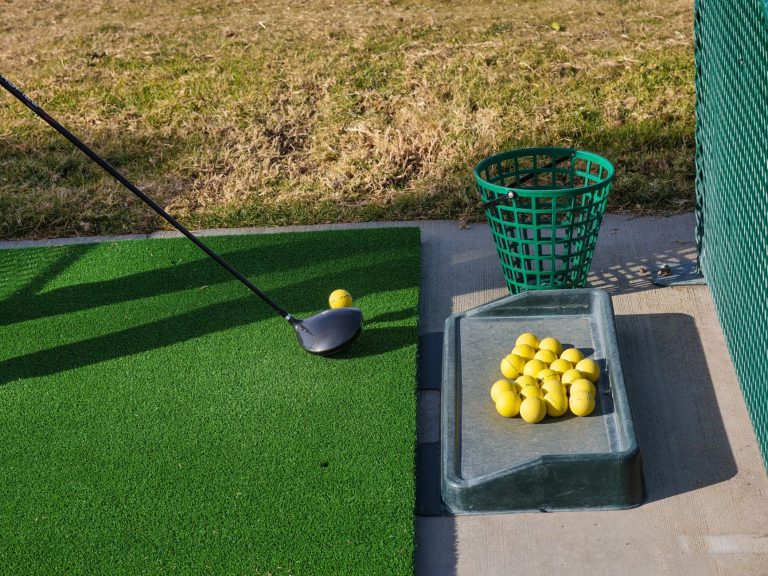
An outdoor session with a launch monitor and real golf balls is ideal because you can see flight and landing. An indoor session is still useful when the unit is calibrated and you understand how it estimates ball flight. If neither is available, use a quiet course session from known markers and collect results over several rounds.
Build the distance map
| Club | Typical carry | Normal range | Decision |
|---|---|---|---|
| Pitching wedge | 118 yd | 114–121 | Keep |
| 9-iron | 130 yd | 126–133 | Keep |
| 8-iron | 143 yd | 139–146 | Keep |
| 7-iron | 155 yd | 150–158 | Keep |
| 6-iron | 165 yd | 157–169 | Check strike consistency |
| 5-iron | 173 yd | 162–177 | Possible overlap |
| 4-hybrid | 176 yd | 171–180 | Test a higher-loft hybrid or 7-wood |
The example does not prescribe distances. It shows how dispersion changes the decision. An eight-yard difference between averages may disappear when both clubs have wide, overlapping patterns. A club that is slightly longer but much easier to launch can still earn its place because its landing angle and rough performance are different.
Where gaps usually appear
Between wedges
Modern iron sets often have a strong-lofted pitching wedge, leaving a large jump to a traditional sand wedge. Check actual lofts before buying another wedge; the name on the sole does not guarantee a consistent progression. You may need a gap wedge, or you may need to learn one dependable three-quarter pitching-wedge shot.
At the long-iron and hybrid transition
Many golfers stop gaining useful carry as irons get longer. Lower loft alone does not guarantee more distance when launch and strike quality fall. A hybrid, high-loft fairway wood, or more forgiving iron may create a better flight and a tighter pattern. Compare outcomes, not categories.
Between fairway wood and driver
A 3-wood can be difficult to launch from turf and may finish surprisingly close to a 5-wood for moderate-speed players. If the shorter, higher-loft club carries almost as far and lands more predictably, the lower-loft club may be redundant. The open slot can go to a wedge, hybrid, or specialty club that solves a real course problem.
Do not solve every gap by buying a club
First check setup and contact. Our golf ball position guide provides a repeatable starting point for the whole bag. If the gap disappears when strike quality improves, equipment was not the cause.
Loft and lie adjustments can change flight, but bending one club affects bounce, launch, spin, and turf interaction. A qualified fitter can evaluate those trade-offs. PING describes full-bag fitting as a process that includes gapping recommendations and encourages golfers to fine-tune online recommendations with a fitter. That is a better use of fitting than chasing a generic distance chart.
How many clubs do you need?
The Rules of Golf allow no more than 14 clubs, but they do not require you to carry 14. A beginner may score better with fewer, clearly separated options. Ten clubs with known carry numbers beat 14 clubs that create doubt. Add a club only when it fills a measurable yardage or shot-shape need.
When to recheck your gaps
- After changing irons, wedges, shafts, lofts, or your normal ball.
- After a meaningful swing-speed or technique change.
- When two clubs repeatedly produce the same approach distance.
- When a club works from a tee but not from the turf where you need it.
- At the start of a season, then again when normal playing conditions return.
Temperature and elevation affect flight, so keep a baseline and add local adjustments rather than rebuilding the entire chart after one cold day.
Frequently asked questions
Should every club be exactly 10 or 15 yards apart?
No. Consistent separation and useful shot coverage matter more than a fixed number. Gaps often become larger at the top of the bag and smaller around wedges.
Should I use average or median carry?
Either can work when the sample is clean. Median carry is less distorted by one unusually long or short shot. Keep the normal range beside the central number.
Can changing the ball alter gapping?
Yes. Launch, spin, speed, and stopping behavior can change, especially with wedges and longer clubs. Test with the ball you normally play before making equipment decisions.
Do partial wedges belong on the chart?
Yes, after full-swing gaps are mapped. Add only partial swings you can reproduce, such as a clock-face or three-quarter motion, rather than inventing a separate swing for every yard.
Bottom line
Measure honest carry patterns, find overlaps and holes, and give every club a clear assignment. Repair contact and setup first, then use fitting or equipment changes where the data shows a real need. The best gapping chart is not the prettiest one—it is the one you trust over a hazard.